Instead of undergoing a transformation from capitalist imperialism to socialism, the European communist states of the late twentieth century, following pressure from the hegemonic West, were politically and economically dismantled by their leaders. The USA became the driver, and winner, of the cold war. Classical imperial capitalism developed into neo-imperialism, David Lane writes.
Imperialism is often identified as a process driving both international conflict and economic exploitation within and between nation states. How should imperialism be understood today, and how might an understanding of its mechanisms contribute to the analysis of contemporary political crises and help to shape appropriate policy responses? In this article, I contend that the classical idea of imperialism has been superseded by a new conception of neo-imperialism which is under challenge in a bifurcated world order. Future trajectories may culminate in forms of ultra-imperialism or super-imperialism or, consequent on the rise of challenger states, facilitate a move to socialist globalisation.
The classical idea of imperialism articulated by Vladimir Lenin was that a territorial division of the world between the dominant European capitalist states and the colonial territories was driven by the necessity of capitalism to expand. This approach shifted the centre of political confrontation from that between classes in capitalist states to wars between dominant capitalist states and to conflicts in subaltern colonial societies. The transformation of capitalism to socialism could be achieved following a revolution in the societies oppressed by colonialism. The emphasis was on the subjugated states in the East, not on the contradictions of capitalism in the dominant capitalist states. The October Revolution of 1917 gave credence to the Leninist approach.
Capitalism, however, was not defeated. Imperialism was not moribund as claimed by Lenin, but was superseded by a more advanced stage: post-industrial globalised capitalism. The division of the world into colonial territories was a phase, not, as claimed by Lenin, the highest point of its evolution. Over the course of the twentieth century, former colonies rejoined the dominant capitalist bloc as economically dependent client states. This did not constitute political colonisation but was rooted in asymmetrical market dynamics, sustained by financial and non-financial transnational corporations, and legitimated through colonial cultural identity.
Lenin’s political prognosis was correct in one respect: capitalism broke down at the weakest economic links in the capitalist chain. But the strongest links held firm and the chain was reinstated and strengthened. The transnational coordination of capitalism - by multi-national corporations, international economic institutions and a transnational capitalist class - replaced the imperialist national form of monopoly capitalism. The rise of the Soviet Union and, later, the formation of a European state-socialist bloc was short-lived. It was an interregnum. Instead of undergoing a transformation from capitalist imperialism to socialism, the European communist states of the late twentieth century, following pressure from the hegemonic West, were politically and economically dismantled by their leaders. The USA became the driver, and winner, of the cold war. Classical imperial capitalism developed into neo-imperialism.
The Rise of Neo-imperialism
Neo-imperialism is defined by multiple forms of formal and informal domination by a core of capitalist countries. Enhanced by the freedom of movement and exchange afforded by globalisation, neo-imperialism involves not only foreign economic investment but also cultural ‘bridgeheads’ to secure approval (moral, economic, political, cultural) in the host country of the home country’s dominant role. It retains from classical liberalism the idea of an exploitative economic relationship between hegemonic and dependent states. In addition, though economic and political issues remain, it shifts the focus to cultural and ideological ones. The greater collective economic and political power of the core Western states gives rise to a neo-imperial form of authority. In various combinations, economic, political, cultural, religious, military, civilisational and national/ideological interests, promote expansion of the hegemonic Western core to envelop subordinate states.
If classical imperialism no longer explains divisions in the world geo-political system, and neo-imperialism is unstable, what social formation could replace it? Political and economic discussion now considers four potential paths forward. Such trajectories are ideal constructions: part theories, part observations of recent developments, and part desirable political and economic developments. First, ultra-capitalist imperialism: a coalescence of multi-national corporations which form a dominant transnational economic cluster. Second, super-state imperialism: a hegemonic state arises as a single world authority. Third, a bifurcated world system, composed of a hegemonic capitalist core, and a contender counter-core. Fourth, globalised socialism: a new social formation transcending capitalism.
What makes the trajectory unpredictable is how different sections of the ruling elites combine in response to counter-elite challenges. Whether global corporations, located in competing political blocs, can coalesce to form a unitary global ruling class. Whether ascendant political counter-elites will accept a subsidiary role under the hegemonic political state, the USA; or, whether there are sufficiently powerful political groups in the ascendant contender states to create an alternative social and economic formation.
Ultra-Capitalist Imperialism
The idea of an ultra-capitalist imperialism predates the twentieth-first century. Karl Kautsky, the Marxist leader of the German Social Democratic Party, writing on imperialism at the beginning of the First World War in 1914, foresaw a coalescence of compatible capitalist states. ‘Imperialism is irrational’, he contended; war destroys life and property; capitalists seek trade and profits, not war. Far-sighted rational capitalists should propose: ‘capitalists of all countries, unite!’. Under ‘ultra-imperialism’, the ‘great imperialist powers may [form] a federation of the strongest, who renounce their arms race’ and in doing so, they would ‘replace [competitive political] imperialism by a holy alliance of the imperialists’ (ibid). In this scenario, wars between the major capitalist states would not occur; the ruling capitalist classes would then peacefully exploit the working classes.
Kautsky, however, underestimated the power of military suppliers and other factions of the ruling classes to foster war and to perpetuate state formations with imperialist objectives. No international ‘holy alliance’ took place. After World War I, the victorious capitalist states pursued their own national interests and competed one against another. National politicians secured further territories for France and Britain, whereas Germany suffered major material losses. National interests (of which capital was one) proved to be stronger than the aggregate of common capitalist economic interests. Later, in Germany, Adolph Hitler’s appeal to the Western liberal states to unite against Bolshevism had some positive response. But there was insufficient transnational support for fascism, and liberal political nationalist forces (later joined by the Soviet Union) unleashed a major war against the Axis powers. Here the class consciousness and self-interest of the transnational bourgeoisie was overwhelmed by national and state political interests. The ultra-imperialism contemplated by Kautsky did not arise. Capital was embedded in national economies with which their economic elites identified.
After World War II, imperialist countries were confronted by the state socialist societies where economies were subject to control by political interests. In Immanuel Wallerstein’s paradigm, market relations are the predominant form of regulation of the world economy which functions as a single economy system (it is a world-system, rather than a world system). In Wallerstein’s approach, the corporations located in the state socialist countries had imperialist tendencies and were also driven by the need for economic accumulation (profit) which they extract from the semi-periphery and periphery. These criticisms fail to address the issue accurately. The state socialist bloc was effectively outside the collective West’s tutelage until the early 1990s. Their economic corporations were owned and controlled by the communist governments. Trade and foreign investment between the hegemonic capitalist bloc and the state socialist societies were negligible. Thus, a move to ultra-capitalism was precluded. It was only in the late twentieth century that the state socialist societies moved towards the world system and accommodation with the Western dominant core of states.
Global Capitalism
Favourable conditions for a shift toward ultra-capitalist imperialism emerged at the end of the twentieth century, driven by the political, economic, and social processes of globalization. Globalisation is ‘a process that erodes national boundaries, integrates national economies, cultures, technologies and governance, and produces complex relations of mutual interdependence’. The international coordinating economic organisations (the IMF, WTO) operated within globalisation processes and, consequently, nation states lost or shared power with regional or international bodies. Territorial political control by dominant states over dependent ones, characteristic of classical imperialism, was replaced by more diffuse forms of power, exercised through transnational exchanges governed by international or regional agreements, laws, and treaties shaped by transnational economic and political organizations.
Globalised capitalism was a new geo-political and economic social formation opening up the possibility of ultra-capitalism. It included the competitive interdependent post-socialist economies of Eastern Europe, the former USSR and China. In the late 1980s, during the period of radical economic reforms in the European state-socialist societies, it appeared that the Western privatisation of state enterprises, and the adoption of market principles at the expense of planning, would move the post-socialist societies into the capitalist world system. By 2001, over 185 countries were members of the IMF and over 150 were members of the World Trade Organisation: the post-socialist societies had joined the capitalist world system. New forms of collaboration arose between regional associations, such as the European Union and the Eurasian Economic Union, and international organisations - the IMF, the WTO, the World Bank, and the United Nations. The welfare states of Western Europe, as well as China, adopted liberal competitive market economics and extended private ownership of productive assets. Foreign direct investment flowed to these states shifting ownership of corporate assets to foreign investors. The enlargement of the European Union with the addition of the post-socialist east European states and the movement of China into the world economic system were steps which merged national capitals. But, again, ultra-capitalism did not arrive.
The main reasons why ultra-capitalism did not materialise are that national capitalisms recognised a threat to their own existence and state-controlled capitalism denied, or severely limited, foreign acquisitions of domestic capital. The political interests embedded in capitalist nation states were averse to losing their powers, and used their control of state power to further their own political interests. When the national interest was threatened by an ascendant globalised capitalist class, national political classes turned against globalisation: epitomised by the slogan, Make America Great Again. Consequently, the ‘fusion of capital’ on a global basis increased, but on a limited scale. Intercontinental imperialist competition continued and stronger regional blocs (EU, Eurasian Economic Union, BRICS) emerged. Regional and national capitalisms (plural) became enmeshed in super-state capitalism.
The Hegemonic World Super-state
Super-state imperialism is an economic formation in which a single capitalist power emerges as a hegemon and other powers ‘sink to the status of semi-colonial powers’. Immanuel Wallerstein called this a ‘world-empire’, which means simply a ‘single political authority for the whole world-system’.
After World War II, the USA exercised multiple forms of control over a wide geographical area. However, it was not a world-empire. A hegemonic world power is a better description which denotes the indirect use of power beyond the borders of the dominant state over other states. By hegemony, Immanuel Wallerstein means that a state ‘for a certain period [is able] to establish the rules of the game in the interstate system, to dominate the world-economy (in production, commerce and finance) to get their way politically with a minimal use of military force …. and to formulate the cultural language with which one discussed the world’. A hegemonic system can operate in a world-economy with a ‘single division of labor, multiple state structures albeit within an interstate system ,… [and] multiple cultures albeit with a geo-culture’.
The strategy adopted by the USA was to develop an international political and economic system composed of institutionally compatible countries, legally and ideationally bound into the Western liberal competitive capitalist model. The United States, according to its leaders, combines might and right: it possesses the political will and armed forces necessary to establish electoral democracy and human rights which, coupled to a market economic system, provide the basis for wealth creation.
Territorial dominance continues in the form of neo-imperialism: dependent countries are modelled on a transnational form of liberal economy, the rules of which are enforced by the super-state both directly and through intermediaries. The United States maintains a massive global military presence. In 2020, it secured 750 bases in 80 countries. Large-scale US military presence has been maintained in industrially developed countries: the largest forces were in Japan (120 bases and 53,713 troops), Germany (119 bases and 33,948 troops) and South Korea (73 bases and 26,414 troops) where such forces could be used against China and Russia. It is notable that a large land mass occupied by India/Pakistan, Africa and Latin America contains only a token American military presence.
It would be incorrect, however, to conclude that the United States does not intervene in foreign countries. Since 2000, it has conducted military action in Afghanistan (2001-2021), Iraq (2003-2011), Pakistan, Libya, Syria, Yemen, Somalia, Philippines, Niger and Iran. Most of the USA’s bases are small stations which are used in emergencies or reinforced for combat roles. Political and economic agreements and ideological accord with the hegemonic state, often working through international agencies, define the rights and responsibilities of collaborating states. The enforcement of the collective interests of the hegemonic state is carried out through economic (particularly financial) sanctions and, in the final analysis, if necessary, by sea and air power.
Following the opening up of China in 1978, and the dismantling of the Soviet European economic and political bloc at the end of the 1980s, the USA became the world hegemonic state. In a period of twenty-four years, between 1990 (formation of post-Soviet Russia) and 2014 (Crimea becoming part of the Russian Federation), the USA had no global political challengers.
But there were always forms of competitive interdependence with other states. During this period, China maintained a different form of economy, polity, ideology and culture, and the limitations on cross-border acquisitions by the China and Russia governments were clearly a major impediment to the rise of an American super-state.
While the USA had world domination in terms of its military capacity and economic resources, neither the American state nor its capitalist class had sufficient ownership of corporate assets on a world scale to establish a governing transnational capitalist class. There arose multi-national, transnational and state economic corporations which lay outside the control of any hegemonic country. The USA was (and remains) the headquarters of a majority of the world’s multi-national corporations. By the end of the twentieth century, China had made significant economic progress and, measured by the number of transnational corporations, was already stronger than Japan and the European states, coming second in the world order, after the USA. In the countries of the Shanghai Cooperation Organisation (SCO), particularly in China, state owned or controlled corporations precluded Western ownership on a large scale. Some commentators сonsider China’s economic and political development to mark the end of Western domination and a shift of power on a world scale to the East. These developments presented a major impediment to the rise either of a super-state or ultra-capitalist form of imperialism and disrupted the globalised economic system.
The Rise of a Bifurcated World System
When, in February 2014, Crimea joined the Russian Federation, limitations on cross-border acquisitions and severe economic sanctions were imposed by the European Union and the USA. Consequently, the international political and economic order has realigned into two principal political areas, signalling the end of uncontested dominance by the core Western states. There remains no unitary ‘global system’. China and Russia have emerged from a state-socialist political formation and retain features of state ownership and political control quite distinct from the core capitalist societies of Europe and the USA. A new geo-political scenario has become apparent, formed by countries which challenge the hegemony of the Western core states. A transcontinental group of ‘contender’ states, with their own ruling classes, has arrived. Their economic power base rests on state-controlled capitalisms which have their own official (chinovnik) class. These contender states, however, and unlike the previous Soviet political bloc, are interdependent with, as well as competitors to, the hegemonic core. They provide a potential political, economic, military and ideological challenge to the capitalist core states in the world geopolitical system.
While these states display substantial variation, they nonetheless possess several common attributes. Members of the post state-socialist states were and remain excluded from the transnational capitalist class. Russia and China are barred from the leading political Group of 7 and the military alliance of NATO. In the economic sphere, William Carroll has shown that boards of Western registered companies contain very few representatives from outside the dominant Western countries. Writing in 2010, he concluded that China and other (misleadingly termed) ‘semi-peripheral’ states (in which he included India) had very few of their citizens among the economic elites of the transnational capitalist class. Of great importance, however, is that private ownership of corporate assets has been introduced successfully in both China and Russia, thus creating a domestic business class. They are all hybrid economies – containing both a public and private sector, and combining forms of state planning with private investment. Thus, the class structure is quite different from that of the state socialist societies of the post-world war II period.
Where they differ from the capitalist core countries is the role which is allocated to the state. This formation cannot be accurately described as ‘state capitalism’ in the sense applied to liberal capitalist systems. In the latter, the state plays a major and necessary role in the coordination of the market and the direction of the economy; the state interacts with civil society, and the market and private property remain dominant. The distinguishing feature of state controlled capitalism is that the state assumes the role of a capitalist actor, there is significant state ownership of corporate property, the state performs entrepreneurial agency and coordinating authority over the whole economy in pursuit of goals defined by the political leadership; surplus value is extracted mainly for public investment. While neo-liberal economic principles are applied domestically (for instance to the labour market, and in consumer price formation), the role of privately owned corporations is restricted, and limits are applied to foreign companies and to mergers with, and purchase of, domestic companies. The rise of state-controlled capitalism created a major barrier to the emergence of ultra-imperialism and presents a challenge to American super-state imperialism.
By the second decade of the twenty-first century, the classical imperial formation of core, dependent semi-periphery and periphery had been replaced by a bifurcation of the international system. The NATO-Ukraine/Russia war was a watershed. As illustrated in Figure 1, the world system is composed of a dominant economic and political core led by the United States and a countervailing group of contender states, notably the BRICS countries.
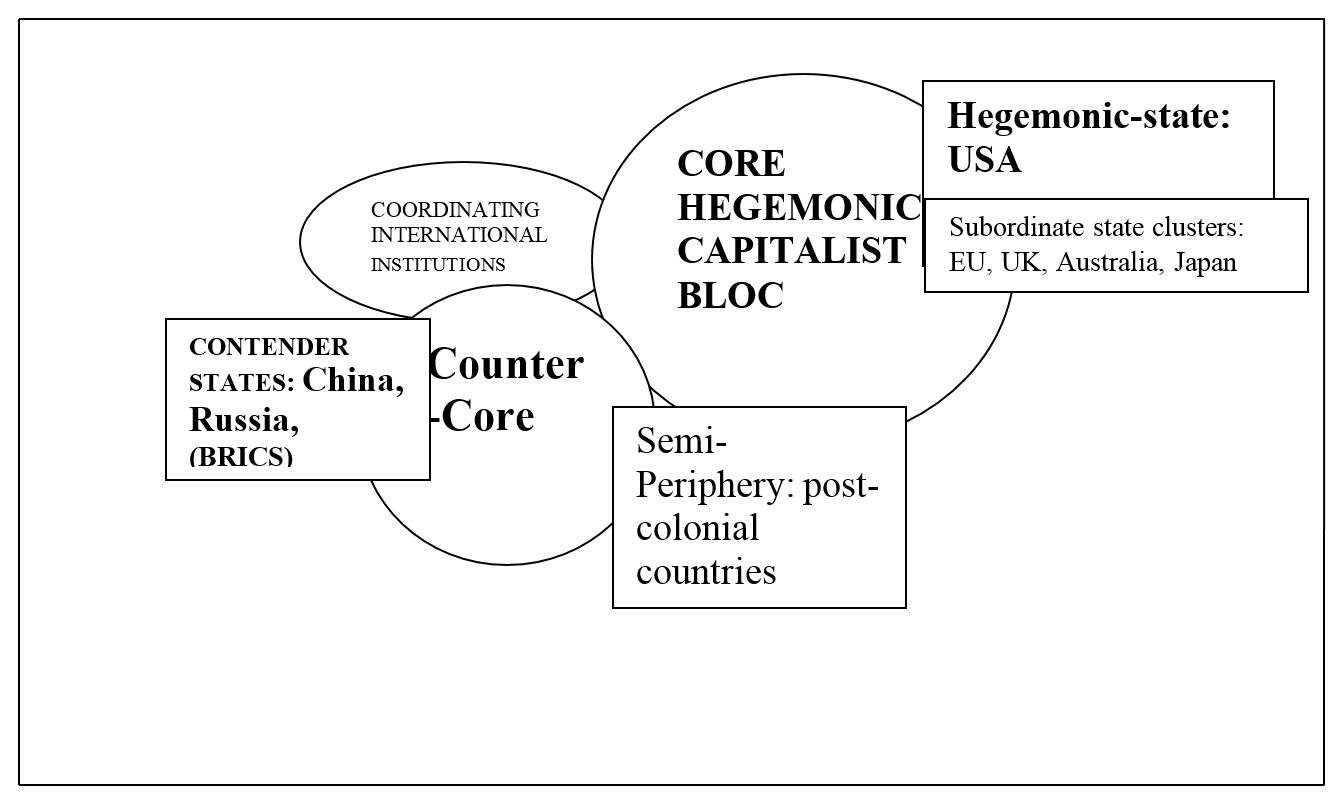
Figure 1. Hegemonic Capitalist Bloc and Counter Core
Neo-imperialism remains an asymmetrical relationship between the collective dominant Western core countries (including the sub-cluster states) and dependent client states. This relationship takes multiple forms: economic, political, military, cultural, ideological and social. Neo-imperialism retains the division of power in the form of the hegemony of the collective dominant Western states, led by the USA. It is backed by military power (NATO) and sustained economically and politically by transnational institutions (IMF, WTO, World Bank) which promote liberal economic and political values. But it does not involve the permanent territorial occupation of, or direct political rule over, dependent states. The dominant powers rule through an international law-governed order backed by economic and political agreements, and military pacts. The use of military force is a power of last resort.
The coordination of advanced capitalism during the early twenty-first century in the form of transnational economic bodies ensured political control of processes of globalisation by the hegemonic core. States retained powers to restrict the rise of a transnational ultra-imperialism. They possess and control their armed and security forces, they make laws and define citizenship, they levy taxes giving economic power, police their borders, and issue their own currency. Moreover, political elites can wield their authority to override the influence of economic corporations. Currently, politically imposed economic sanctions penalise not only recipients, who are denied products and services, but also businessmen, who lose sales and profits, and their employees, who are denied income.
A Transition to Socialist Globalisation?
State-controlled capitalist societies increasingly challenge the liberal democratic economic order. Their institutions integrate national and transnational economic activity under centralized political authority. However, their intentions are not inherently malign. The leaders of China and Russia envision a multipolar international system distinct from the collective West’s competitive market economy and adversarial political framework. Such an approach proposes a multipolar world order based on the recognition of ‘civilisational differences’, and strengthening multilateral institutions. Under President Xi Jinping, a vision of global economic development is proposed, aiming at the ‘common prosperity of the world and a brighter future for humanity.’ This vision represents a significant ideological challenge to Western liberalism.
Some Western academic commentators even suggest it could signal a shift towards globalised socialism. Such a prognosis remains speculative, it is rooted in the perception that the crises of global capitalism, exacerbated during the Trump administration, will remain unresolved by current international bodies. The convergence of these crises may destabilise Western states and lead to a retreat from the liberal model. In this context, a new economic and political order, led by the ‘challenger’ states, may arise. Such an order could emerge either as a form of collectivist socialist globalization or as a form of capitalism shaped by socialist components (a hybrid economy).
The envisioned goal is a form of globalisation that safeguards national sovereignty while promoting peace, ecological sustainability, participatory democracy, social equality, and human rights. These objectives are positioned as alternatives to military posturing, profit-driven economic growth, competitive electoral democracy and consumerist ideology. Current coordinating institutions, such as the IMF, WTO, World Bank, and United Nations, would, where necessary, be restructured to facilitate inclusive global development. In a cooperative, multipolar political order, priority would be placed on peace-building and mutual prosperity. Transnational economic organisations would move from advocating market-led growth to supporting developmental models aimed at universal prosperity.
This aspirational framework could set the stage for global leaders to take decisive actions that would transform wishful thinking into tangible progress: either towards inter-civilisational co-existence or socialist globalisation.


