In a certain sense, the Vietnam War was a clash of strategic approaches, writes Professor Vladimir Kolotov, Director of the Ho Chi Minh Institute at St. Petersburg State University, Head of the Department of History of the Far Eastern Countries at St. Petersburg State University. The US relied on game theory, while the Vietnamese side, demonstrating the hammer and sickle to the enemy, relied on good old-fashioned Far Eastern strategematics, which the Americans did not even suspect. Each side was waging its own war.
Following the defeat of France in the First Indochina War, the US, trying to put up a barrier to the spread of communism in Southeast Asia in accordance with the “domino theory”, endeavoured to replace the pro-French regime in South Vietnam with a pro-American one. For these purposes, Catholic Ngo Dinh Diem was brought to Saigon from the United States, who, with the support of the CIA, was to turn South Vietnam into an outpost of the so-called free world in Southeast Asia. However, the French did not want to give up South Vietnam, which served as the cause of the French-American conflict, which lasted until the summer of 1955.
The pro-French National Unified Front of religious sects could not cope with the South Vietnamese army, on which Ngo Dinh Diem relied, and at the head of the next Saigon regime was an American protege who relied on representatives of the reactionary Catholic clergy, the military elite, and the Personalist Labor Revolutionary Party. The highest posts in the Republic of Vietnam were distributed between Ngo Dinh Diem’s brothers. In the field of ideology, the stake was placed on repression against communists and the forceful spread of Catholicism, which by 1963 had led to the “Buddhist crisis”. In protest against the Ngo Dinh Diem regime’s policy of religious discrimination at the state level, one of the spiritual leaders of South Vietnamese Buddhism, the supreme monk Thich Quang Duc, committed public self-immolation, which caused a major international scandal. During the confrontation that unfolded in South Vietnam, a decision was made in Washington to replace Diem, who was removed as a result of a military coup in November 1963.
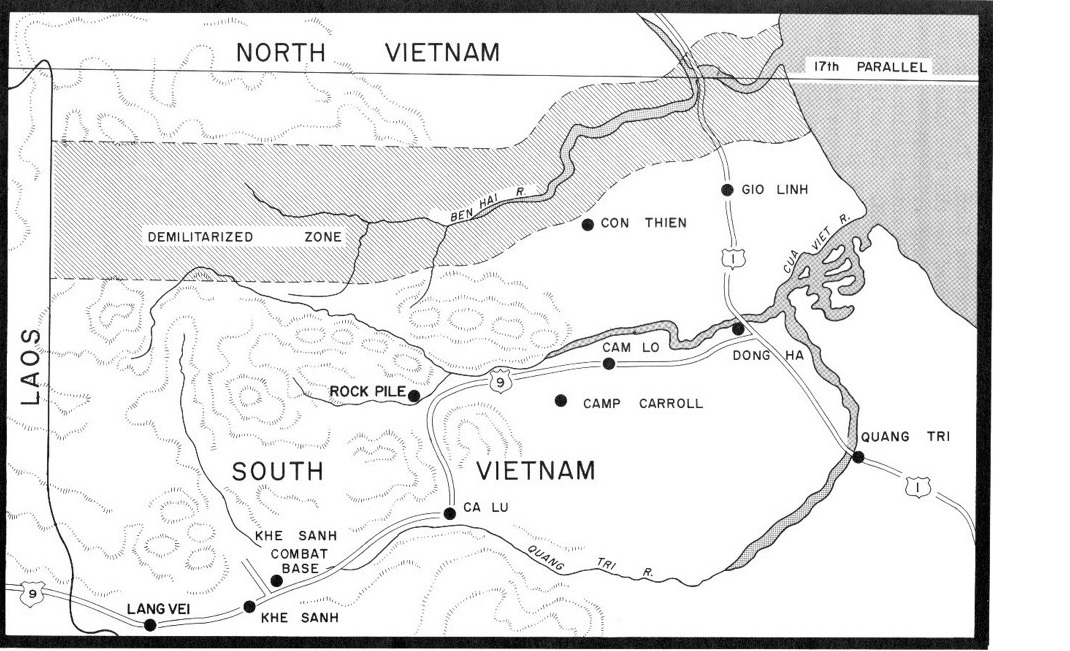 Saigon military men began to come to power one after another. The regime was only stabilized with difficulty by 1965, when regular US military units began to be brought into South Vietnam in addition to the thousands of military advisers already there, since support for the DRV’s policies was growing as a result of the growth of the liberation movement. This was largely due to the “Ho Chi Minh Trail” – a system of strategic communications that, since 1959, had been used to transfer personnel, equipment, and weapons from North Vietnam to the South through Laos and Cambodia. The map of a divided Vietnam drawn in the Pentagon offices, with a demilitarized zone in the middle – the McNamara Line (see map) – was considered an insurmountable barrier. American strategists could not imagine that the northerners would bypass the obstacle and go south through the territory of neighbouring countries.
The war had not yet officially begun, but the balance of power had already begun to change in Hanoi’s favour. At the same time, the National Liberation Front of South Vietnam (Viet Cong) was created with a system of power parallel to Saigon. In the Battle of Ap Bac in January 1963, Saigon troops under the command of American advisers suffered their first defeat in an open clash.
The decade between the wars (1955–1965) was used by the opposing sides to prepare for the continuation of the struggle. The DRV advocated for the unification of the country under Hanoi’s rule, while the USA strived to maintain control over the southern part of the country. Despite all the efforts of the United States in South Vietnam, they failed to undermine the positions of the liberation forces with punitive operations. In order to rectify the situation, it was decided to send military advisers first, and then regular troops.
The conflict in the Gulf of Tonkin between North Vietnamese patrol boats and an American destroyer led to the lightning-fast appearance of the Tonkin Resolution of 1964, which gave the Johnson administration the go-ahead to bomb the territory of the DRV and deploy US troops in South Vietnam. In 1965, a large-scale landing of American troops took place in Da Nang. By 1968, more than half a million US soldiers and officers were in the Republic of Vietnam, complementing the approximately 2 million servicemen of the Saigon army. Despite victorious reports, the expectation of the defeat of the liberation forces did not come true. On the New Year according to the lunar calendar, in late January 1968, the strategic general uprising known as the Tet offensive began in the Republic of Vietnam. More than a hundred cities and large settlements were attacked simultaneously. Even the American military base Khe Sanh was under siege. The unexpected offensive shocked the American army and its allies. Losses in manpower and equipment increased. The US Army’s frustration often culminated in violence against civilians, most infamously in the My Lai massacre, where American soldiers killed over 500 unarmed people, the majority of whom were women and children.
With losses mounting, Defense Secretary Robert McNamara and the commander of American forces in Vietnam, Gen. William Westmoreland, were dismissed. Significant losses in manpower and equipment, as well as the lack of prospects, forced Washington to begin the Paris talks, which, with interruptions associated with the periodic escalation of military action in order to put pressure on the enemy, lasted from 1968 to 1973. The opposing sides carried out one operation after another, and the arena of confrontation gradually encompassed the territories of not only the DRV and the Republic of Vietnam, but also the neighbouring countries of Laos and Cambodia. In fact, this is why the conflict entered historiography under the name of the Second Indochina War. Against the backdrop of increasing losses and the development of the anti-war movement in the United States, President Nixon, who took office in 1969, put forward the concept of the “Vietnamisation of the war”, which provided for the transfer of the burden of military action to the Saigon army, with the gradual withdrawal of American troops from the blows of the liberation forces. However, despite their obvious advantages in the military-technical sphere, firepower and mobility, the balance of power on the battlefield did not favour the United States. The battle for the hearts and minds of the local population, based on Catholicism, was completely lost by Washington and the Saigon regime. Massive assistance, primarily from the USSR, China and other socialist countries, played a huge role in strengthening the military-technical and defence potential of the DRV. Of particular importance were the air defence systems and combat aircraft supplied by Moscow, which put a stop to the undivided dominance of the US Air Force in the skies of the DRV.
In December 1972, in an attempt to put pressure on Hanoi, the United States sanctioned the mass bombing of the DRV, which, thanks to Soviet air defence systems and fighter aircraft, led to major losses for the US Air Force. This operation was called “Dien Bien Phu in the Air” by the North Vietnamese. In 1973, after signing the Paris Agreements, the United States withdrew its troops from South Vietnam, leaving significant amounts of military aid to the Saigon regime, which was able to hold out for only two years. “An important role in the victory was played by the strategy developed by the Vietnamese leadership, which, in a revised and modernized form, combined Sun Tzu's laws of war and Vietnamese techniques of protracted war.” Based on the knowledge of the laws of war from Ho Chi Minh's translations of Chinese military classics, the VPA command analysed in detail the future theatre of military operations. In Saigon, the territory of the Republic of Vietnam was divided into four tactical zones from north to south. From the demilitarized zone to the south, zone 1 (Da Nang), then to the border with Laos, zone 2 (Nha Trang, Quy Nhon), the Capital Region, zone 3 (Saigon), and the Mekong Delta, zone 4.
 Tactical zones 1, 3 and 4 of the Saigon government (see map) were considered inconvenient for conducting offensive operations, since zone 1 contained powerful fortified areas intended to contain the VPA along the sea coast. Hanoi chose tactical zone 2 and struck not from the north, as the enemy expected, but from the west, from the Central Tay Nguyen Highland. This theatre of military operations could be isolated and, using limited reserves, control could be established over it. Having captured this bridgehead, the VPA cut through the enemy forces and, from the heights, threatened all enemy forces in the south in zones 1 and 3, which put them in a vulnerable position. After this strike, the defence of the RV collapsed.
Tactical zone 1 with powerful fortified areas and the “McNamara line” was surrounded between the VPA forces in the north, on the heights in the west, and the captured zone 2, from where a blow was launched at Saigon (zone 3), during which resistance in zones 1 and 4 lost all meaning. At this point, the war was over, and the world watched amusing live footage of the evacuation of the American embassy from Saigon and North Vietnamese tanks on the lawn in front of Independence Palace, which had served as a symbol of the South Vietnamese government for decades.
Thus, on May 30, 1975, during the strategic Ho Chi Minh Operation, Saigon was liberated and Vietnam was unified under the auspices of Hanoi. The following year, the united Vietnam became known as the Socialist Republic of Vietnam (SRV).
If we compare the level of awareness of the opposing sides about the enemy, then Hanoi knew its enemy much better than Washington. The density of the “fog of war” was different and the Vietnamese, in accordance with Sun Tzu’s law of war "知己知彼" (know yourself, know others), saw the strengths and weaknesses of the enemy better, found vulnerabilities and methodically struck there.
In a certain sense, this war was a clash of strategic approaches. The US relied on game theory, while the Vietnamese side, demonstrating the hammer and sickle to the enemy, relied on good old Far Eastern strategematics, something the Americans did not even suspect. Each side was waging its own war. American intelligence Lieutenant General Phillip Buford Davidson in his monograph “The Vietnam War” described in vivid colours the atmosphere that reigned in the Pentagon. Chaos in strategy led to chaos on the battlefield, and what seemed quite logical in the spacious offices in Washington, did not stand up to the collision with reality in the tropical jungle. Some may think that the Vietnam War falls into the category of “things of the past” and that its parameters are irrelevant in modern times, but “despite the decades that have passed since the US war in Vietnam, it is still remembered as an exemplary asymmetric conflict, when a clearly weaker side was able to achieve a convincing victory over a stronger enemy.”
Knowledge of the classical laws of war, on which the development of the correct strategy adequate to the situation is based, as well as the identification of the enemy’s vulnerabilities, allows you to deliver crushing blows to his defence, which lead to victory even in the conditions of a pronounced asymmetric conflict.
The Vietnam War is unique not only in its use of a hybrid system of combining eastern and western strategies, but also in its results. During the Cold War, only Vietnam was able to achieve a convincing victory and unify its national territory. Other countries divided by geopolitical contradictions were never able to fulfil this historical mission, and some are still forced to maintain foreign military bases with all the ensuing consequences.


