We are currently experiencing a period reminiscent of 1914, when the UK was the global leader and the British pound sterling the dominant currency, but the country lacked the military, economic, and financial power it once enjoyed. The same is happening today in the United States, writes Abdullah bin Abdulmohsen Al-Faraj. The article was prepared for the 22nd Annual Meeting of the Valdai Discussion Club.
Over the next 10-15 years, the world order will be shaped by a number of factors, the most important of which are:
1) The development of the global economy and the emergence of previously non-existent major economies.
China and India are at the forefront. The economic growth of China and India accelerated as part of a new cycle of global development following the collapse of the Soviet Union, which was accompanied by the opening of previously closed markets and increased profits for Western companies, particularly American ones, which invested a significant portion of their profits in China and India. Consequently, the economies of both countries grew at an accelerated pace. Between 2000 and 2007, the Chinese economy grew from $1.2 trillion to approximately $3.6 trillion, a threefold increase. Its economy quickly became larger than those of France, the UK, and Germany.
However, this cycle ended in 2008 as a result of the global financial and economic crisis, with the US at its epicentre, following the subprime mortgage crisis and the bankruptcy of several major American banks and other companies, including Fannie Mae, Freddie Mac, Lehman Brothers and General Motors. A new cycle of global economic development began. In 2010, China’s economy overtook Japan’s, becoming the second-largest economy in the world. India also witnessed accelerated economic growth.
A study prepared by the UK-based Centre for Economics and Business Research (CEBR) predicts that by 2038, China will become the world’s largest economy. Consequently, the US economy will fall from a position it has held since the end of World War II to second place. The centre also projects that India will become the world’s third-largest economy starting in 2033, as shown in the table. By 2075, Goldman Sachs projects that India will become the world’s second-largest economy.
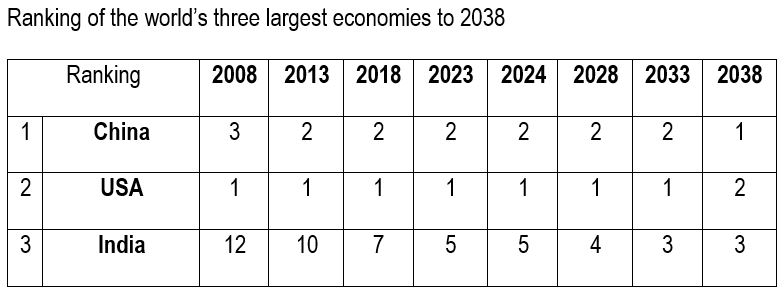
Source: The Centre for Economics and Business Research.
Similarly, the Russian economy has grown significantly in this new economic cycle, despite more than 3,000 sanctions. In purchasing power parity (PPP) terms, the Russian economy has improved its ranking, becoming the fourth-largest economy in the world starting in 2021, surpassing Japan and other developed economies.
Thus, the world order has entered a transitional phase that happens once every century.
We are currently experiencing a period reminiscent of 1914, when the UK was the global leader and the British pound sterling the dominant currency, but the country lacked the military, economic, and financial power it once enjoyed. The same is happening today in the United States.
If the predictions of the aforementioned think tanks come true, they will shift the paradigm. This will pave the way for the emergence of a new world order and international law, distinct from what currently exists. From the ruins of the United Nations, a new international organisation will emerge, reflecting the new balance and centres of power in the world.
2) The development of military power by several countries.
Russia stands out in this area due to its success in producing numerous hypersonic missiles, such as the Avangard, Sarmat, Bulava, Kinzhal, Zircon, Burevestnik, and the Poseidon unmanned underwater vehicle.
The United States is attempting to counter the ongoing transformation of the global order, or at least slow the process as long as possible. This includes imposing tariffs on trade competitors, attempting not only to impose its economic agenda and thereby slow down trends predicted by global think tanks, but also to forcibly establish a favourable political balance – as in the case of the tariffs imposed by the United States on India to prevent it from purchasing Russian oil and prevent a rapprochement between Moscow and New Delhi. Not only will it fail, it will also accelerate the emergence of a new world order.


