The future of the UN remains uncertain, as over the next four years, if it contradicts US national interests, the organisation will face a difficult financial situation that other states are unlikely to be able to remedy, Inna Yanikeyeva writes.
The United Nations (UN) General Assembly’s 80th Anniversary High-Level Meeting is taking place on September 22, 2025. “UN representatives and heads of state and government will reflect on the achievements of the past eight decades and ways to build a more inclusive and responsive multilateral system,” the organisation’s website states. Of particular interest is Donald Trump’s upcoming speech, which will provide insight into the US approach to the UN over the next four years.
The return of Donald Trump to the US presidency marked another stage in the development of global governance and has already led to the reconsideration of several of Washington’s positions on key international institutions, including the UN, to which the United States is the largest donor. In the first weeks of his second term, Donald Trump has taken a number of steps that could impact the functioning of the UN. The Trump administration has once again expressed scepticism toward the organisation, initiating a second withdrawal from several of its structures, reviewing its funding mechanisms, and outlining its approach to interaction with the organisation.
With Trump’s return to the US presidency, the UN faces new challenges related to yet another policy shift by the organisation’s largest financial contributor. The review of financial commitments, withdrawal from several structures, and abandonment of international obligations are creating a new reality for the UN. Under these circumstances, the UN faces the need to adapt to new challenges and find new funding methods to maintain its role in international relations over the next four years.
Trump and International Institutions
Trump’s stated approach to the UN and other international organisations is not unexpected. During his first term, he clearly demonstrated scepticism toward multilateral organisations and a desire to limit US participation in global institutions that run counter to the country’s national interests. His first administration openly advocated funding cuts for international institutions, declaring a reconsideration of the US role in global governance.
For example, in 2017, the United States announced its withdrawal from the UN Educational, Scientific and Cultural Organisation (UNESCO) due to its anti-Israeli position and a US law prohibited funding the organisation, which had granted membership to the Palestinians in 2011, but it returned to the organisation in 2023 under the Biden administration. In 2018, the United States withdrew from the UN Human Rights Council, arguing that the structure was biased, but it returned in 2021. Similarly, in 2020, the United States officially began the process of withdrawing from the World Health Organisation (WHO), citing distrust of its actions in the context of the COVID-19 pandemic, then history repeated itself.
Trump has also criticised other international organisations, such as NATO and the World Trade Organisation (WTO), questioning the effectiveness of these institutions. His policy is based on the America First principle. This is reflected in reduced American participation in international initiatives and a focus on bilateral agreements instead of cooperation within international structures.
At the same time, it is important to note that despite Trump’s statements during his first term, funding for the UN as a whole has increased (from $10.4 billion in 2017 to $11.6 billion in 2020). During the Biden administration, a reverse trend was observed: $12.5 billion was allocated to the UN system in 2021, then $18 billion in 2022, and then funding fell to $13 billion in 2023 (see Appendix 1). At the same time, there was open talk of resuming funding cuts during Donald Trump’s first presidency.
Annex 1.
The amount of US funding for the UN
Source: UN System Chief Executives Board for Coordination. URL: https://unsceb.org/fs-revenue-government-donor
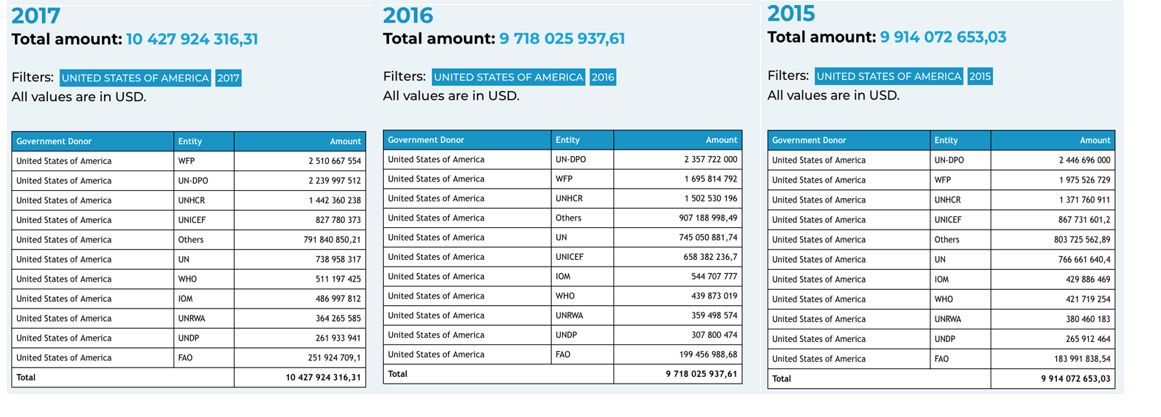
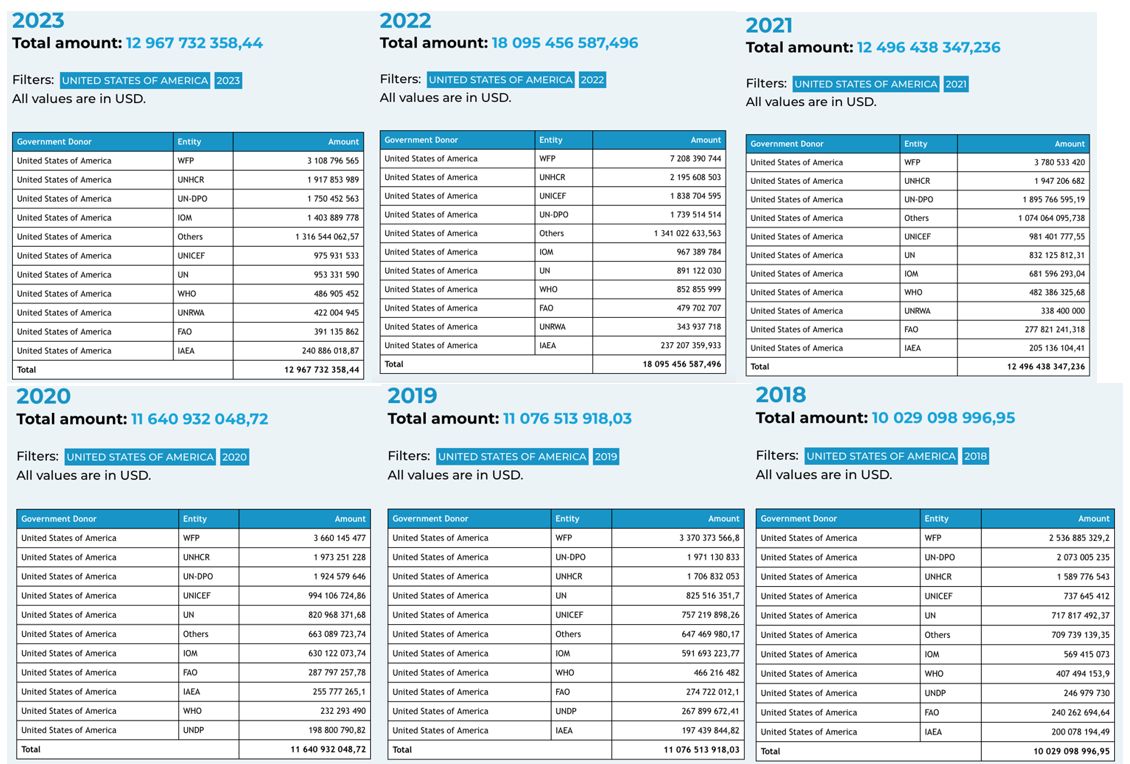
Source: UN System Chief Executives Board for Coordination. URL: https://unsceb.org/fs-revenue-government-donor
The steps taken by the newly elected US president have already demonstrated a continuation of the policies pursued during his first term, including a distrust of multilateral cooperation mechanisms and a desire to redefine the global agenda in line with American national interests. In particular, the steps taken by Joe Biden to reintegrate the US into organisations from which it had withdrawn before him are once again being reversed by the newly elected head of state. In this context, it is important to note that Donald Trump’s motives for cutting funding, withdrawing from international organisations, and his overall foreign policy remain purely pragmatic. His goal is to ensure that American national interests are upheld and advanced in all areas at any cost (without harming Washington), in the spirit of business deals.
Thus, when Trump sees value for the United States in interacting with certain actors, whether organisations or states, he builds relationships with them that are beneficial to Washington. For example, in early 2017, he hosted representatives of the UN Security Council at the White House and urged them to impose sanctions on North Korea, arguing that the UN has enormous potential. Furthermore, under Trump’s first administration, the UN received more funding than under Barack Obama. Despite announcements of funding cuts and its withdrawal from a number of organisations, during Donald Trump’s first presidency, the United States remained involved in those institutions that, from his perspective, served the national interests of the United States (for example, the World Food Program, the UN Department of Peace Operations (UN-DPO), the Office of the United Nations High Commissioner for Refugees (UNHCR), UNICEF, and others), typically increasing their funding annually. Thus, if the United States sees value in an organisation, it remains involved and may even increase its funding.
Expectedly, from the first days of his second term, Donald Trump outlined a policy of limiting US participation in multilateral institutions that operate in conflict with American national interests. Thus, in January 2025, the United States withdrew from the WHO and the Paris Climate Agreement, and in February 2025, an executive order was signed on the US withdrawal from the UN Human Rights Council (UNHRC), which was again explained by the bias of this structure and its divergence from Washington’s position. This step was a repeat of his decisions in 2018, when the US withdrew from the UNHRC for similar reasons. The need to reconsider US participation in UNESCO was also stated and, as a result, a withdrawal from the organisation was announced. It appears that this factor has the potential to have a negative impact on the effectiveness of international programmes implemented under the auspices of the UN.
Furthermore, Washington initiated a review of US participation in all international organisations, including financial institutions such as the World Bank. Meanwhile, Moody’s warned of a possible downgrade of the credit ratings of multilateral development banks if Washington reduces its support for these institutions. This warning followed Donald Trump’s executive order to review US participation in all international organisations, which could lead to reduced funding and a reduction in US influence in these organisations. Another area of Washington’s criticism of the UN has been initiatives related to inclusion, diversity, and gender equality (DEI) policies, implemented by UN agencies such as UNICEF and UN Women. In this regard, the United States may reduce or stop funding UN agencies implementing “equality and social justice” programmes if they do not revise them, which jeopardises millions of dollars in support from Washington. This reflects the Trump administration’s domestic policies, specifically aimed at eliminating DEI practices and so-called “gender ideology.”
At the same time, there is a clear tendency to use financial leverage–reducing financial commitments to the UN. Thus, Washington announced the cessation of funding for the UN Human Rights Council, and the UN Relief and Works Agency for Palestine Refugees in the Near East (UNRWA). The United States was previously the largest donor to the UNRWA, and the cessation of its funding jeopardises programmes to support millions of Palestinian refugees. Incidentally, in 2018, the US suspended funding to this organisation. It is important to note that in his draft budget for fiscal year 2026, Donald Trump proposed to stop funding UN peacekeeping operations.
The Trump administration has also reviewed US participation in global climate initiatives. In February 2025, a planned $4 billion contribution to the Green Climate Fund, created to support developing countries in the fight against climate change, was cancelled. This undermines collective efforts and jeopardises the implementation of environmental projects in developing countries. This decision was justified by the need to revise international agreements, which, according to Trump, are detrimental to US economic interests. This step creates problems for developing countries and ongoing climate projects. At the same time, it is interesting that the head of the Green Climate Fund stated that there are no possible negative consequences for global climate initiatives in connection with this decision.
Adapting the UN to the New Reality of International Relations
Trump’s second term as president is posing a serious challenge to the UN and the multilateral governance system as a whole. With limited US financial assistance available globally, the UN is faced with the need to revise, at a minimum, its funding mechanisms and, at a maximum, its structure and programmes. The main challenges for the organisation are financial sustainability and independence from the US (searching for new donors and redistributing budget flows), political legitimacy (balancing the interests of various global power centres), and the effectiveness of institutional mechanisms (adapting to changes in the international order). The ability to mitigate emerging threats will determine the fate of the organisation over the next four years.
At the same time, the reaction of the international community to US steps towards the UN indicates growing concern about the organisation’s prospects, particularly among diplomats and international officials at the UN, who, incidentally, stated that organisations can cope with a possible US withdrawal and funding cuts, but it will not be painless. In turn, UN Secretary-General Guterres noted that the UN will conduct a large-scale restructuring of work, which implies significant budget and staff reductions. According to him, all Secretariat units in New York and Geneva have been asked to review their functions to determine whether some of them can be performed from existing locations at a lower cost (choose less expensive locations) or whether they can be reduced or abolished. “We’ve already seen significant cost savings in New York by terminating the lease on one building and relocating staff to other existing spaces, and we expect to close two more buildings when their leases expire in 2027, realising significant savings,” he said.
It appears that funding cuts and the US withdrawal from key international structures could weaken the organisation’s position on the global stage, as well as the US within these institutions, while simultaneously strengthening the influence of other powers and groups, such as China and BRICS. China, for example, is seeking to expand its influence within UN structures by promoting initiatives focused on the interests of developing countries. However, their ability to compensate for the financial and political vacuum left by the US exit remains questionable. One possible way to adapt to the current situation could be to expand the role of the BRICS countries, which traditionally advocate for reform of the global governance system.
Thus, Donald Trump’s second term marks a new stage in the evolution of the US attitude toward international organisations in general and the UN in particular. The policy of reducing participation in international organisations and reconsidering financial obligations poses serious challenges to the organisation and raises questions about the UN’s future, as it could lead to a weakening of its position in the global system. This is especially true given that the US could raise the stakes even higher by significantly reducing its contributions to the UN system, as proposed during Donald Trump’s first term, or by halting funding for peacekeeping operations, as proposed in the draft budget for fiscal year 2026. Incidentally, UN funds for programmes which contradict the policies pursued by the Trump administration, for example, regarding abortion, climate, and the environment, are highly likely to be cut.
Given the return of the America First policy, the UN faces the need to rethink its structure and funding principles, which could impact its effectiveness and ability to respond to international crises in the long term. If the UN wants to maintain US engagement in international organisations, it will have to reform its programmes and institutions to recapture Washington’s interest in its activities. At the same time, the decline in US involvement opens new opportunities for other actors. For example, under these circumstances, the role of the BRICS countries in reforming global governance could significantly increase.
The future of the UN remains uncertain, as over the next four years, if it contradicts US national interests, the organisation will face a difficult financial situation that other states are unlikely to be able to remedy. Furthermore, if the UN decides to accommodate US interests, it will lose its neutral status – its foundation – and may lose the support of other member states. On the other hand, Trump can contribute to increasing the effectiveness of the UN, given his statements that the organisation has great potential, and that based on this potential, the United States will continue to cooperate with it, but for this it needs to improve the quality of its functioning, since now “it is not coping with its job.”


